Table of Content

Plinko Online: Mechanics, Demo Mode, Risk Levels, RTP and Real-Money Play

Last updated: 20 February 2026 · Reading time: ~15 minutes · Audience: 18+ only

In two sentences: Plinko is a physics-flavoured arcade gambling game in which a ball drops through a pyramid of pegs and settles in a multiplier pocket, with the result decided by a random number generator rather than by skill. This guide explains how the board works, how rows and risk levels reshape volatility, how the two leading builds differ (BGaming at 99% RTP, Spribe at 97% RTP), what demo mode does and does not teach you, and what Australian law says about playing for real money.

Plinko Online Mechanics, Demo Mode, Risk

Quick verdict before you read on

A short summary for anyone who wants the shape of the answer first, then the detail.
  • Fairness:both leading builds publish a Provably Fair seed and hash. That verifies the algorithm, not the operator's finances or licence.
  • Best value version:BGaming's Plinko at 99% RTP beats Spribe's Plinko Classic at 97%. That is a 1% house edge against 3%, and it is the only genuinely better choice the game offers you.
  • Bonus and offer terms:Plinko usually counts partially, or not at all, towards wagering. Check game weighting, max bet per round and expiry before you accept anything.
  • Australian legality:real-money online casino play is prohibited for residents under the Interactive Gambling Act 2001. Free demo and social versions are widely available.
  • Who should skip it:anyone chasing losses, anyone drawn in by a stream clip, and anyone who reads "99% RTP" as "I get 99% of my money back this session".
Quick verdict before you read on

That last point deserves a whole section, and it gets one.

  1. Plinko in one glance: the Galton board goes digital

Plinko is the online casino descendant of two things: the peg-board prize game made famous by the television program The Price Is Right, and a much older piece of statistical apparatus known as the Galton board (or bean machine). Sir Francis Galton's device showed that when a ball branches left or right past fixed obstacles, again and again, the landing positions form a bell-shaped, binomial-type distribution. Dense in the middle. Sparse at the edges.

Online Plinko is that same experiment with money attached. Each bin at the base of the pyramid carries a multiplier. The bins the ball reaches most often pay the least, frequently below your stake, and the bins it almost never reaches pay the most. Everything else, from colours and sound to autoplay and "hot and cold" statistics panels, is presentation layered over that distribution.

Two facts follow, and they frame the whole article:

  • There is no skill component. You choose settings before the drop. After that, the branching path and the RNG decide.
  • Sub-1x pockets dominate the middle of every board. Frequent "wins" that return less than the stake are structural, not bad luck.
1. Plinko in one glance the

2. What the Plinko game is and how its gameplay is structured

2.1 Core mechanics

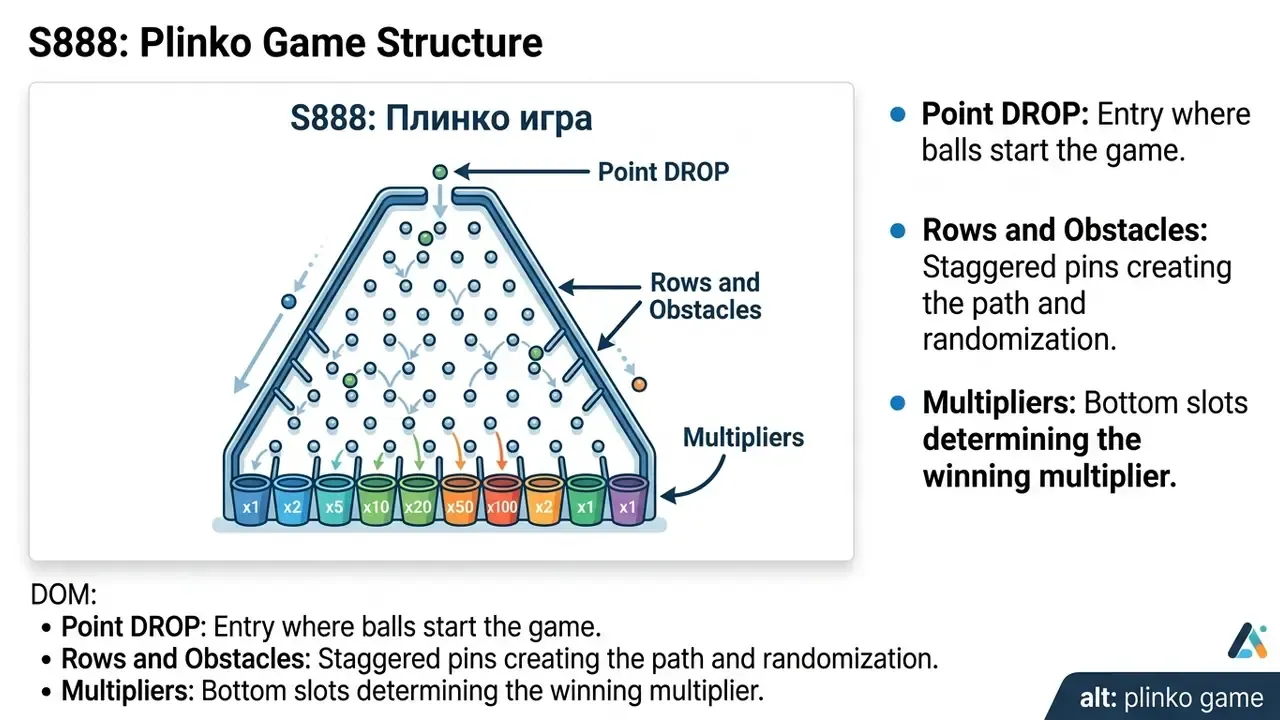
A round of Plinko has four moving parts:

  1. Bet size, charged per ball dropped rather than per session.
  2. Rows (pegs or lines), the height of the pyramid, usually adjustable between 8 and 16.
  3. Risk level, low, normal/medium or high, which redistributes the multipliers along the base.
  4. Drop, where the ball is released from a single point at the top centre, collides with pegs row by row, and is deflected left or right by each collision until it settles in one bin.

The payout is instant and mechanical: stake × multiplier. A $1 stake landing in a 3.7x pocket returns $3.70. The same stake landing in a 0.3x pocket returns 30 cents. Most versions keep a rolling ticker or record table of recent results, which players read far more meaning into than it holds.

Online casino builds keep this visual lineage but wrap it in a crash-style framework: fast rounds, manual or auto betting, and a live results feed. Readers comparing available titles and providers can review current online casinos with Plinko before committing any funds.

2.1 Core mechanics. A round of

2.2 The board layout, in plain terms

  • One release point, top centre.
  • Rows of pegs beneath it: 8, 12, 14 or 16 in most commercial builds, with some crypto-native versions extending to 20, 24 or 28.
  • A symmetrical bottom row of bins, where the lowest multiplier sits in the centre (commonly 0.2x to 0.5x depending on risk) and rises outward to the extreme edge pockets, from roughly 18x on low risk up to 555x or 1,000x on high risk, depending on provider.

Because branching is symmetrical at every row, the distribution of landing positions is roughly symmetrical around the centre. The number of possible paths through a board of n rows is 2ⁿ, and the number of paths leading into each bin follows the binomial coefficients. That is precisely why the single outermost bin is astronomically rarer than the middle ones.

2.2 The board layout, in plain

2.3 Differences between Plinko and other online games

Compared with a video slot, the Plinko game strips out wilds, scatters, paylines, free spins and bonus buys. Compared with a table game such as blackjack, it removes decision-making entirely: no in-round choice changes expected value. What it adds is player-configurable volatility, the ability to move the same house edge across a wider or narrower spread of outcomes.

That configurability is often marketed as "control", and precision matters here. You control the shape of the distribution, never its average. From an evidence perspective, there is no research suggesting that any skill-based approach alters long-run outcomes.

2.3 Differences between Plinko and other

"Social casino game engagement was significantly associated with monthly monetary gambling, even after adjusting for demographics and impulsivity." Source: Hing et al., New Zealand Ministry of Health (2025). https://www.health.govt.nz

So the free, "just for fun" framing around many Plinko builds is not neutral. Engagement with simulated gambling products is measurably linked to later monetary betting.

3. Playing Plinko online: setup, drop, RNG and Provably Fair

3.1 Setting up a round: bet, rows, risk and autoplay

  • Bet, the per-drop stake. In autoplay it is multiplied by the number of scheduled drops, which is the single most common way players burn through a bankroll faster than intended.
  • Rows, where more rows widen the base and lift the ceiling, yet push probability further away from the edges.
  • Risk level, which reshapes the payout table. High risk does not simply raise the edges. It also cuts the centre, and the centre is where most balls land.
  • Bet mode, either Manual (one drop per click) or Auto (a scheduled series of drops). BGaming's build offers both, plus a record table of past results.

Here is the sequence I would follow before releasing a single ball, in the order that protects the bankroll best.

  1. Set your session budget in dollars first, then divide by your intended number of drops to get the stake. Not the other way around.
  2. Choose rows: 8 to 12 for a narrow, lower-variance board, 14 to 16 for a wide, high-ceiling board.
  3. Choose risk: green/low, yellow/medium or red/high.
  4. Double-check the stake field. Every ball costs one full wager.
  5. Press Bet to drop one ball, or configure Auto with an explicit stop-loss and stop-win.
  6. Read the multiplier the ball lands in. The payout is credited immediately.
  7. Log the result. Sessions feel very different from ledgers, and ledgers rarely flatter anyone.
3.1 Setting up a round bet

3.2 Drop, RNG and independence of rounds

Each drop is generated independently. Earlier outcomes carry no information about the next one. A run of ten 0.3x results does not make an edge pocket "due", and a "hot game" badge reflects past variance rather than future probability. The record table is entertainment, not a forecasting tool.

Because the interface foregrounds a headline RTP figure alongside a scoreboard of recent big multipliers, players can easily overestimate their chances despite the prevalence of sub-1x pockets.

"An RTP message stating a 90% payout raised perceived chances of winning, with an odds ratio above 5 compared with no information." Source: Weiss-Cohen et al., Addictive Behaviours (2025), N = 6,062. https://pubmed.ncbi.nlm.nih.gov

In other words, the very disclosure meant to inform players can inflate expectations. A 97% or 99% figure reads to many people as "I will get most of my money back", when it actually describes a theoretical average across millions of rounds.

3.3 Provably Fair: what it does and does not prove

Both the Spribe and BGaming builds are marketed as Provably Fair. The mechanism is straightforward enough to check yourself in a minute or two:

  • The server seed is generated by the operator and published in advance as a cryptographic hash, typically SHA-256, inside the game's "Provably Fair" menu.
  • The client seed is generated by your browser and is usually editable.
  • Combined with a nonce (the round counter), those seeds produce the ball's path.
  • After the round, or after the seed is rotated, you can reveal the server seed, re-hash it, and confirm it matches the hash published before play. If it matches, the trajectory was fixed before the ball fell.

What Provably Fair verifies is the algorithm. It does not verify that a balance is real money, that a stream is not running on promotional credit, or that a site holds a licence. Algorithmic honesty and financial legitimacy are two separate audits, and only one of them is on display.

3.3 Provably Fair what it does

4. Rows, risk and multipliers: the maths of the board

4.1 Choosing the number of rows

  • 8 to 12 rows: a narrow pyramid. Balls cluster near the centre, so outcomes concentrate around roughly 0.5x to 1.5x. This is the setting best suited to stretching a small balance, or to grinding slowly where a bonus even permits it.
  • 14 to 16 rows: a wide base. The probability of reaching an extreme outer bin drops below 0.01% on high-risk configurations, while the maximum multiplier climbs to 555x (Spribe) or 1,000x (BGaming).

Adding rows therefore increases both the ceiling and the variance while leaving the theoretical return untouched.

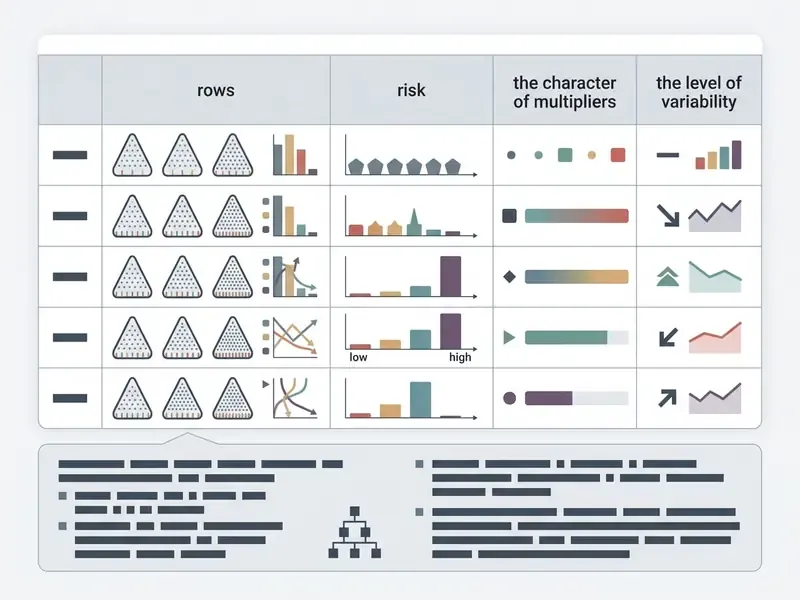
4.2 The three-tier risk system

Risk levelCentre pocketsOuter/edge pocketsFeel
Low (Green)~0.5x to 0.9xup to 18x to 35xFrequent small returns, shallow drawdowns
Medium (Yellow)~0.3x to 0.7xup to 55x to 118xBalanced, with occasional meaningful hits
High (Red)as low as 0.2xup to 555x (Spribe) / 1,000x (BGaming)Long dry spells punctuated by rare spikes

Note the trade-off plainly: high risk reduces what the most probable outcomes pay. The extra ceiling is funded by the middle of the board, which is to say by you.

4.3 Linking rows and risk to RTP

RTP is calculated by summing every possible multiplier weighted by its probability. Because the provider tunes the table so that this sum stays constant, moving from green to red, or from 8 rows to 16, changes the distribution and not the expected return. A well-configured board at 99% RTP carries a 1% house edge whether you pick the safest or the wildest setting. Only your bankroll trajectory changes.

Players who prioritise theoretical return over spectacle can compare titles at high-RTP casino games, keeping in mind that RTP is a long-run figure rather than a session forecast.

4.3 Linking rows and risk to

4.4 Volatility and perceived risk

Volatility describes the spread of outcomes. RTP describes their average. Over a few hundred drops, a high-risk 16-row board can comfortably return 40% or 250% of turnover. That gap between short-run experience and long-run expectation is where most misperceptions live, and it widens when a player's first exposure is free play.

Australian evidence on simulated gambling is blunt: adolescents who engage with simulated gambling are significantly more likely to gamble with money later.

"Young people who played simulated gambling at 16 to 17 were around 40 per cent more likely to gamble with real money at 18 to 19." Source: Australian parliamentary inquiry into online gambling (2024), drawing on Growing Up in Australia data. https://www.aph.gov.au

4.5 RTP information, streams and misperceptions

Plinko's visual clarity makes it exceptionally streamable. Ball, pegs, multiplier: legible in a two-second clip. That is also why highlight reels of 555x and 1,000x hits circulate far more widely than the thousands of 0.2x drops that funded them. Streaming can reinforce the cognitive biases and strategy illusions described above.

"Most viewers of gambling streams reported that watching encourages rather than discourages their own betting." Source: NSW GambleAware, Live streaming gambling: Who watches, why and what effects is it having? https://www.gambleaware.nsw.gov.au

4.6 Comparing the two leading versions: BGaming vs Spribe

Most Plinko games you meet online are one of two builds. Confusing them is the most common error in Plinko guides, because the ceilings and house edges differ materially.

ParameterPlinko by BGamingPlinko Classic by Spribe
RTP99% (house edge 1%)97% (house edge 3%)
Maximum multiplierx1,000 (16 lines, high risk)x555 (16 pegs, red risk)
Rows / pegsAdjustable, 8 to 16 linesAdjustable, 12, 14 or 16 pegs
Risk systemLow / Normal / HighGreen (low) / Yellow (medium) / Red (high)
Bet modesManual and Auto, plus record tableManual, three coloured drop buttons
Max bet / max payoutUp to ~$100 / up to ~$100,000 (operator-dependent)Up to ~$100 / up to ~$55,500 (operator-dependent)
FairnessProvably Fair (server and client seed)Provably Fair (cryptographic hash)
Game type / releaseCasual, released 28 January 2019Casual arcade

Reading the table: on identical stakes and identical settings, the BGaming build returns two percentage points more of turnover over the long run. Spribe's version compensates with a tighter, more legible three-button interface. Neither offers a bonus round, a gamble feature or a progressive jackpot, so the 555x or 1,000x cap works as a quasi-jackpot.

"If two builds of the same game sit side by side and one gives back two extra percentage points, that is the decision. Everything else in Plinko is decoration." Claire Bennett, senior casino content editor

5. Plinko demo and Plinko free: what free play teaches and what it hides

5.1 What demo mode is good for

Free play is genuinely useful for three narrow purposes: learning the interface, seeing how row count reshapes the bins, and feeling the difference between green, yellow and red before money is involved. BGaming and most aggregator sites host a Plinko demo that runs in the browser with no registration and no download.

Practical use of a demo session, if you want one:

  • Drop 20 balls on 8 rows, low risk. Watch how tightly the results cluster.
  • Switch to 16 rows, high risk. Drop 20 more. Count how many land under 1x.
  • Compare the two record tables. That contrast is the honest lesson of free play.
5.1 What demo mode is good

5.2 What demo mode cannot teach

It cannot teach variance at a scale that matters, and it cannot teach bankroll discipline, because nothing costs anything. A hundred drops in a plinko free build is statistically meaningless against a distribution whose top outcome sits below 0.01%.

5.3 Gold Coins, Sweeps Coins and free play are not the same thing

Three distinct models get blurred together constantly:
  • Free demo:play money, no prizes, no redemption.
  • Social casino / Gold Coins (GC):play money inside a persistent account, often purchasable, with no cash redemption.
  • Sweepstakes / Sweeps Coins (SC):promotional entries that may be redeemable for prizes in some jurisdictions. Predominantly a United States model, not an Australian one.
5.3 Gold Coins, Sweeps Coins and

5.4 Inflated payout rates and misrepresentation

This is the most important warning on the page. Players who practise in demo mode can form inaccurate expectations about volatility and return, and that is not always accidental.

"Demo games on operator sites often have inflated payout rates and are designed to mislead players into moving to the paid version." Source: Hing et al., New Zealand Ministry of Health (2025). https://www.health.govt.nz

Treat a winning streak in a free build as a marketing artefact until proven otherwise. If a demo feels unusually generous, that is a reason for suspicion, not confidence.

6. Plinko real money: legality, offer terms, limits and maximum wins

The Interactive Gambling Act 2001 (IGA) is the primary legislation governing online gambling in Australia. It prohibits the supply of real-money online casino-style games, including Plinko played for cash, to Australian residents. The Australian Communications and Media Authority (ACMA) enforces it, partly through website blocking of offshore operators. Readers wanting the wider market picture can review our overview of iGaming in Australia.

Social casinos, by contrast, sit outside the IGA because they lack real-money stakes or withdrawable winnings.

Practical consequence: a large share of the sites ranking for "plinko real money" are offshore and unlicensed for Australian players. Unlicensed and script-based Plinko clones offer no guarantee of payout, no dispute resolution, no data protection and no independently verified odds. Sites that ask for a deposit before showing licensing details, or that publish a "Provably Fair" tab with no verifiable hash, are not borderline cases. Skip them.

6.2 Online gambling participation and Plinko's place in the market

Independent data on Plinko's specific market share, player numbers or growth rate is not publicly available. Claims that Plinko is "one of Australia's fastest-growing casino categories" originate in operator and affiliate marketing material rather than regulator statistics, so read them as promotional positioning instead of measured fact. What can be evidenced is the broader participation trend that Plinko sits inside:

"36% of Australian adults gambled online in some form, up from 32% in 2023; lotteries led at 78%." Source: ACMA, How we use the internet (2024). https://www.acma.gov.au

Plinko's visibility is best described from what is observable. It appears widely in provider catalogues (BGaming's Plinko, Plinko 2, Football Plinko), in crypto-casino "originals" line-ups, and across demo aggregators. That documents availability, not audience size. Participation data specific to Plinko remains an evidence gap, and pretending otherwise would be the easy option.

6.3 Which offer terms to check before your first bet

Most players arrive at a plinko casino through a welcome offer rather than the game itself. That is where the real conditions hide, and arcade titles are treated differently from slots more often than people expect.

Work through this list before you accept anything:

  1. Game weighting. Does Plinko contribute 100%, 10% or 0% towards wagering? Casual and arcade titles are frequently excluded outright.
  2. Wagering multiple and expiry. A 35x requirement over seven days is a very different product from 35x over 30 days.
  3. Max bet while a bonus is active. Breaching a $5 cap with one careless drop can void the entire balance.
  4. Max cashout. Some offers cap winnings from bonus funds at a fixed figure regardless of the multiplier you hit.
  5. Eligibility and payment exclusions. Certain deposit methods are commonly excluded from bonus qualification.
  6. KYC timing. Verification requested only at withdrawal is a familiar source of delay and frustration.
  7. Country and provider restrictions. Check that the specific build is available in your jurisdiction at all.

Compare the offer twice: once as advertised, once after the terms. The gap between those two readings tells you more about a brand than any star rating.

6.3 Which offer terms to check

6.4 Betting limits and how much you can actually win

Limits and maximum wins are set by the operator rather than the game, and they vary widely. Two documented reference points from regulated overseas markets show the range:

  • BetMGM Plinko: stakes from $0.10 to $100 per drop. On maximum rows and high risk, hitting an outermost pocket with the full $100 stake would return roughly $362,380.
  • High 5 Casino Plinko: a range of 0.20 SC to 500 SC, where the same extreme outcome at 500 SC would return about 1,600,000 SC.

Both figures are technically real and practically negligible. On a 16-row high-risk board, the chance of landing one specific outer bin is well under 1 in 30,000 drops. Multiply that by the stake required and the expected cost of chasing the corner becomes obvious fairly quickly.

6.4 Betting limits and how much

7. Plinko strategy: what works, what cannot, and why

Disclaimer: this information is general in nature and is not financial or gambling advice. Gambling involves a risk of losing money.

7.1 The pure-chance nature of Plinko

Plinko has no strategic layer. Once the ball is released, no input alters the outcome, and no configuration alters the house edge. Every "system" sold as a plinko strategy manipulates one of two variables, stake size or risk setting, and neither touches expected value:

  • Stake size scales results linearly. Betting $1 or $100 changes the magnitude of wins and losses, not the average return per unit staked.
  • Risk level changes variance only. Low risk delivers frequent small returns, high risk delivers rare large ones. Both sit on the same negative expectation.

7.2 Bankroll management: the only defensible discipline

Bankroll rules do not create an edge. They control exposure and duration, which is a legitimate goal on its own terms:

  1. Decide the total amount you are prepared to lose before you open the game.
  2. Size each drop at a small fraction of that amount, often 0.5% to 1%, so the session survives ordinary variance.
  3. Set a hard stop-loss and a stop-win, and treat autoplay limits as binding rather than advisory.
  4. Prefer the higher-RTP build, 99% over 97%, where both are available. It is the only choice in Plinko that measurably improves long-run return.
  5. Never lift stakes to recover losses. Martingale-style progressions on a game with sub-1x central bins escalate exposure without improving the odds.
7.2 Bankroll management the only defensible

7.3 Fact check: "guaranteed" Plinko strategies

Claims of guaranteed-win Plinko scripts, pattern trackers and paid predictors fail on first principles. Outcomes come from an RNG, verifiable via seed and hash in Provably Fair builds, each round is independent, and the payout table is fixed in advance. No published standard, regulator finding or provider document supports a 100% winning method for an RNG game. Any product sold on that premise is, at best, selling variance, and at worst harvesting deposits or login credentials.

Choosing a risk level and a stake is money management. It is not a route to a fixed win, and it is worth being honest with yourself about the difference.

7.3 Fact check guaranteed Plinko strategies

8. Plinko mobile and Plinko download: playing on a phone

8.1 Mobile internet use and online gambling in Australia

Australian internet use is overwhelmingly mobile-first, with 92 per cent accessing the internet through their phones multiple times a day.

"36% of Australian adults gambled online in some form, up from 32% in 2023; lotteries led at 78%." Source: ACMA, How we use the internet (2024). https://www.acma.gov.au

8.2 Plinko mobile and download options

Plinko is built in HTML5, so it runs inside a mobile browser session with no installation. The W3C published HTML5 as a Recommendation in 2014, defining browser-executable application content, which is why the same plinko demo loads on a desktop, a tablet and a phone without a separate package. A plinko download is therefore rarely necessary. Downloadable casino applications are installed software distributed outside the browser runtime: a delivery channel, not a different game.

One practical note on portrait mode. On narrow screens, 16-row boards are often scaled down until the outer pockets are barely readable, which makes it easier to misjudge which multiplier you actually landed in. Check the payout ticker rather than the graphic.

There is no Plinko-specific research on mobile play patterns. It is fair to observe that always-available, one-tap access removes friction from any gambling product, and that Australian evidence links simulated gambling exposure to later monetary betting (see §4.4). A specific claim that mobile Plinko amplifies harm remains unmeasured, so treat it as a hypothesis rather than a finding.

8.2 Plinko mobile and download options

8.3 Plinko wins on streams (Drake, Twitch, Kick): what is the catch?

Enormous Plinko wins on livestreams, six figures from a single drop, are technically possible but not representative of an ordinary player's experience. Three factors explain the gap:

  • Sponsorship capital. Large gambling streams are almost always sponsored, and sponsorship typically comes with substantial starting balances supplied by the platform for marketing purposes. Casinos use these streams as promotion and are not always transparent about the funding arrangement.
  • Stake ceilings ordinary players will not use. Maximum drops of $100 or 500 SC generate the headline figures. At those stakes, the cost of the losing drops between highlights is rarely shown on screen.
  • Selection bias. Clips are edited. The 1-in-30,000-plus outcome gets uploaded. The thousands of 0.2x drops do not.

Specific claims that streamers routinely receive off-stream refunds or top-ups are not supported by published research or regulator findings, and are not asserted here. What is documented is the sponsorship-funded model above, plus the effect of viewing on audiences:

8.3 Plinko wins on streams Drake

"Most viewers of gambling streams reported that watching encourages rather than discourages their own betting." Source: NSW GambleAware, Live streaming gambling: Who watches, why and what effects is it having? https://www.gambleaware.nsw.gov.au

Verification is also thinner than it looks. Provably Fair confirms that the algorithm produced an honest trajectory. It cannot confirm that the on-screen balance was real money rather than promotional or demo credit. Without wallet history, round IDs, nonces and account mode, a headline stream win stays unverified.

  1. FAQ about Plinko online

9.1 How do I verify a drop through Provably Fair?

Each drop is generated from a server seed created by the casino, a client seed created by your browser, and a nonce. Before the round, the SHA-256 hash of the server seed is published in the "Provably Fair" menu. Afterwards, reveal the server seed, re-hash it, and confirm it matches the pre-published hash. That is proof the trajectory could not have been altered mid-flight.

9.2 Are online Plinko wins on streams real?

The wins are generally genuine game outcomes, but the conditions are not comparable to normal play. Streams are usually sponsored and funded with balances supplied for marketing, stakes sit at or near the maximum, and only the winning clips circulate. Treat them as advertising rather than evidence of achievable returns.

9.3 How do different versions of the Plinko game differ from each other?

Mostly in three parameters: rows, risk tiers and the multiplier table. BGaming allows 8 to 16 lines with Low, Normal and High risk, and caps at 1,000x on 99% RTP. Spribe offers 12, 14 or 16 pegs with green, yellow and red risk, and caps at 555x on 97% RTP. Crypto-native clones may extend to 20 or more rows with entirely different edge multipliers, so read the paytable of the specific build rather than assuming.

9.4 Which version of Plinko is most favourable?

BGaming's Plinko at 99% RTP is mathematically better value than Spribe's Plinko Classic at 97% RTP, a 1% house edge against 3%. Spribe's ceiling is 555x, BGaming's is 1,000x.

9.5 Is there a guaranteed winning Plinko strategy?

No. Every bounce follows a random branching process, the Galton board in digital form, rounds are independent, and no staking pattern or autoplay schedule changes the house edge. Bankroll rules manage exposure. They do not create an edge.

9.6 What is the maximum win in Plinko?

It depends on the provider: 555x on Spribe's Plinko Classic (16 pegs, red risk, outermost pocket) and 1,000x on BGaming's Plinko (16 lines, high risk). Cash caps are set by the operator, for example up to about $55,500 on Spribe builds and roughly $100,000 on BGaming builds at maximum stake.

9.7 How many rows should I choose?

For steadier play and longer sessions, 8 to 12 rows with low or medium risk. For maximum ceiling and maximum variance, 16 rows with high risk, accepting that central pockets then pay as little as 0.2x.

9.8 Does the record table or the "hot/cold" panel help?

No. It records history. Each drop is independent, so past results carry no predictive information about the next one.

9.9 Can Australians play Plinko for real money?

Real-money online casino games are prohibited for Australian residents under the Interactive Gambling Act 2001, and ACMA actively blocks offshore sites. Free demo play is widely available. Social casino products sit outside the IGA because they lack real-money stakes or withdrawable winnings.

9.10 Does Plinko have bonus rounds, free spins or a progressive jackpot?

No. There are no wilds, scatters, paylines, bonus buys, gamble features or progressive jackpots. The maximum multiplier acts as the de facto jackpot.

9.11 Is a Plinko demo identical to the paid version?

Not necessarily. Independent research has found that operator demo games can carry inflated payout rates specifically to nudge players towards paid play (see §5.4). Do not calibrate your expectations on a free build.

  1. Responsible gambling and further reading

Plinko's appeal is its transparency: one ball, one distribution, one multiplier. That same transparency makes its economics easy to state honestly. A fixed negative expectation, sub-1x pockets across the middle of every board, and a headline multiplier most players will never see.

If gambling is affecting you or someone you know, free and confidential support is available in Australia 24/7 through Gambling Help Online on 1800 858 858. Deposit limits, session reminders and self-exclusion tools exist on licensed platforms for a reason, and setting them before a session is far easier than during one.

Content on this page is intended for readers aged 18 and over and is provided for information and entertainment only. It is not legal, financial or gambling advice, and the outcomes described are theoretical figures published by providers and operators rather than promises of return.

Editorial note: figures in this guide come from provider documentation (BGaming, Spribe), operator limit disclosures (BetMGM, High 5 Casino), and the Australian and New Zealand regulator and academic sources cited inline. Where independent data does not exist, notably on Plinko's market share and on Plinko-specific mobile behaviour, the article says so rather than filling the gap with marketing claims.

10. Responsible gambling and further reading