Table of Content

Poker Online: Rules, Hand Rankings, Demo Play, Strategy and Live Casino Formats

Last reviewed: January 2026 · Reviewed by: Claire Bennett, Senior iGaming Content Editor

Online poker gives digital access to classic card disciplines, from peer-to-peer Texas Hold'em tournaments through to live dealer casino tables. Before a real wager goes in, one habit separates informed play from guesswork: reading the table rules, betting constraints, hand structures and compliance details first.

That sounds obvious. Most players skip it anyway.

«A sensible approach to online poker starts with inspecting the fine print, understanding the mathematical structure of the game, and placing personal risk management above any headline promotion or win claim.» Claire Bennett, Senior iGaming Content Editor (editorial commentary)

Poker Online Rules, Hand Rankings, Demo

Quick summary: what matters before you play

  • Two structural models exist:player-versus-player (PvP) poker rooms, where the operator takes a rake and you compete against other people, and house-banked casino poker (RNG or live dealer), where a fixed paytable and a built-in house edge decide the maths.
  • Hand rankings are fixed and mathematical:ten tiers, from High Card (50.11% of random five-card hands) up to Royal Flush (0.00015%).
  • Demo mode teaches mechanics, not profitability.Free-play results carry no predictive value for real-money outcomes.
  • Legality in Australia:under the Interactive Gambling Act 2001, it is the operator, not the individual player, that commits an offence by supplying prohibited real-money interactive gambling to Australian residents. The ACMA blocks non-compliant offshore sites, and BetStop provides national self-exclusion.
  • Biggest practical gaps for new players:payment method availability, KYC verification timelines and withdrawal limits, all covered in the dedicated payments section below.
  • Who should avoid it:anyone playing with money needed for essentials, anyone chasing losses, and anyone under 18.
  • Help in Australia:Gambling Help Online, 1800 858 858 (24/7), and BetStop (national self-exclusion register).
Quick summary what matters before you

General information disclaimer: This guide is general information about card game rules and formats. It is not financial, legal or clinical advice, and it does not replace consultation with a qualified professional. Real-money gambling is restricted to adults aged 18+ in jurisdictions where it is lawful.

How this guide was reviewed, and the terms you will meet

Every claim below sits in one of three buckets: published game rules, peer-reviewed or government research, or clearly labelled editorial judgement. Payout schedules and probabilities come from standard 52-card combinatorics and provider paytables. Legal statements come from the Interactive Gambling Act 2001 and ACMA guidance. Anything that reads like an opinion is flagged as one, because a review that blurs the two is not much use to anyone.

A short vocabulary check first. These terms appear throughout, and misreading them is where most costly mistakes begin.

  • Rake. The operator's commission taken from a PvP pot or tournament buy-in. It is a fee for hosting, not a bet against you.
  • House edge. The built-in mathematical advantage in banked casino poker, expressed as a long-run percentage of turnover.
  • RNG. Random number generator, the certified software that deals cards when no physical dealer is present.
  • Showdown. The reveal at the end of a hand, when remaining players compare five-card holdings.
  • Kicker. A side card used to break a tie inside the same hand category.
  • Blinds and ante. Forced bets posted before the deal to create an initial pot.
  • Equity. Your statistical share of the pot, given the cards you hold and your opponent's likely range.
  • Outs. Unseen cards that would complete your drawing hand.
  • KYC. Know Your Customer, the identity verification step required before payouts.
  • Rollover (wagering requirement). The turnover you must generate before bonus funds convert into withdrawable cash.

Keep those ten in mind and roughly 90% of the confusion around poker rules and bonus terms disappears.

How this guide was reviewed, and

What online poker is and what it offers

In two sentences: Online poker is a family of internet-delivered card games split between competitive PvP rooms and house-banked casino tables. The commercial and mathematical logic of each model is different, so the format you pick shapes your risk profile before a single card is dealt.

Online poker refers to digital adaptations of classic poker games played over the internet, on desktop platforms or mobile devices. The online poker landscape splits structurally into two distinct models: player-versus-player poker rooms and operator-banked casino poker games. In PvP online poker, participants compete against other human poker players, with the platform acting solely as a host and taking a small rake from each pot. RNG and poker live casino formats work differently: the player faces a live dealer or a software algorithm under fixed paytables and an established house edge. That distinction comes from the rules of each game rather than from participation statistics.

[FIGURE: Comparative architecture of PvP poker versus casino poker. Caption: "Player interaction models in online poker".]
Purpose: Separate competition against other users from competition against the house.
Semantics: figure + figcaption; alt: "Diagram showing the split between PvP poker rooms and house-banked casino poker games".

Choosing an online poker game brings flexible stake limits, so users can move between micro-stakes tables, fixed-limit formats and high-roller tournaments. Research on digital gambling participation indicates that while online poker remains a specialised niche compared with lotteries or electronic gaming machines, gambling activity in Australia keeps shifting toward digital channels, as documented in national participation research.

What online poker is and what

«Among online poker players, more than one-third played weekly and 10% played daily.» Gainsbury & Blaszczynski, Australian Online Gambling Survey (2017)

Nationally representative participation data show continued migration of gambling activity to online channels among Australian adults. Australian National University Gambling Participation Survey, Suomi et al. (2024)

Online platforms provide automated deal mechanics, multi-table capability and constant availability. That accessibility cuts both ways, though, and it demands cautious bankroll management, because faster dealing raises the number of hands played per hour well above a land-based casino table. A single online table can deal 60 to 90 hands per hour. Four tables running in parallel can pass 300 hands per hour, compressing months of live-room variance into one evening.

In commercial review audits, including our team's structural analysis of iGaming operator environments (see our iGaming brand and compliance review), transparent software certifications and verifiable operator credentials proved essential for judging platform safety. When you inspect a digital card room, checking licensing, game fairness audits and payout terms prevents hidden payment friction and protects the account balance. In practice, that audit runs in a fixed order: licence number, then RNG or live-studio certification, then the withdrawal clause buried in the terms.

Online platforms provide automated deal mechanics

Poker demo and poker real money: how the two modes differ

In two sentences: Demo poker uses valueless virtual chips and exists to teach mechanics; poker real money adds financial consequence, verification requirements and psychological pressure. Free-play performance is not evidence of real-money skill.

The primary difference between poker demo modes and real-money tables sits in the financial stakes and the risk profile of the session. A poker demo environment uses virtual chips with zero monetary value, letting users inspect mechanics, test software responsiveness and read the rules without exposure. Real-money poker play involves depositing actual funds, where every bet, call, raise or fold moves a real bankroll.

Empirical research into simulated gambling shows that demo games work well as educational tools for learning starting hand structures and table actions. Peer-reviewed data is blunt about the limit, however: free-play success should never be treated as a signal of real-money profitability.

Poker demo and poker real money

«54% of real-money online gamblers had also engaged in simulated gambling, showing higher engagement and higher levels of harm.» Fiedler, Ante, Meduna et al., representative survey of 46,136 German internet users (2024)

Free-play environments strip out the psychological salience of financial risk, which routinely alters behaviour and produces betting patterns nobody would repeat with their own money on the table. Two further cautions apply. First, unlicensed or script-based «demo» poker games are not independently certified, so their dealing logic and displayed win rates cannot be verified. Treat an inflated demo win rate as a marketing artefact, not a performance baseline. Second, moving from demo poker play to cash bets means adjusting to real betting friction, account verification and strict deposit limits.

Free-play environments strip out the psychological

Readiness checklist: moving from demo to real money

Readiness signalNot ready yetReady to consider real stakes
Rules knowledgeStill checking hand rankings mid-handCan rank any two hands instantly, including kickers and the wheel
BankrollMoney required for rent, bills or debtDiscretionary funds only; a loss would not change your month
Session disciplinePlay until «even» after a losing runFixed stop-loss and time limit set before the first hand
Format understandingUnsure whether the table is PvP or house-bankedKnows the rake or house edge for the chosen table
Account controlsNo limits configuredDeposit, loss and session limits set before first deposit
VerificationID documents not availableID, address proof and payment proof ready for KYC

Legal notice and disclaimer: Real-money online gambling is strictly restricted to adults aged 18 and over, in jurisdictions where legislation permits it. Under Australia's Interactive Gambling Act 2001, the provision of unlicensed real-money online poker to domestic residents is restricted. Players must verify local laws, platform licensing status and operator terms before registering or wagering real funds. This information is general in nature and does not replace professional advice; real-money online gambling is governed by the legislation of the user's own jurisdiction.

In two sentences: The Interactive Gambling Act 2001 targets the supply of prohibited interactive gambling services, not the individual who plays them. That distinction matters, because offshore poker rooms can be blocked and disciplined by the regulator while players carry the practical risk of unrecoverable funds.

Key points for Australian residents:

  • The prohibition sits on operators. The IGA 2001 makes it an offence to provide or advertise prohibited interactive real-money gambling services, online poker included, to customers physically located in Australia. The Act sets no penalty for the individual placing the bet.
  • Enforcement is administrative and technical. The Australian Communications and Media Authority investigates complaints against offshore operators and can ask internet service providers to block access to non-compliant websites. Sites can therefore vanish mid-session or become unreachable without notice.
  • Consumer protections are limited offshore. If an unlicensed operator withholds a withdrawal, voids a bonus or closes an account, Australian dispute-resolution channels generally have no jurisdiction. The complaint path runs through the offshore licensing body, assuming one exists.
  • Age restriction is absolute. Real-money play is 18+ in every Australian jurisdiction.
  • BetStop is the national self-exclusion register. Registration blocks accounts and marketing from Australian-licensed interactive wagering providers. Offshore poker rooms sit outside that perimeter, which is exactly why offshore play is harder to step away from.
Is online poker legal in Australia

Poker rules: objective, cards, betting order and equipment

In two sentences: Poker is won by holding the best five-card hand at showdown, or by betting so that everyone else folds first. A standard 52-card deck, clockwise action and forced blinds create the structure every variant builds on.

The objective of classic poker is to win the common pot, either by constructing the highest-ranking five-card combination at showdown or by betting in a way that forces all opponents to fold before the reveal. A standard game uses a single 52-card deck with four suits (Spades, Hearts, Diamonds, Clubs) of 13 ranks each. Table action moves clockwise, starting from the left of the dealer button, which keeps betting rounds structured across all streets.

[FLOWCHART: Sequence of a poker hand]
Purpose: Show the hand step by step, from forced bets to showdown.
Semantics: ordered list describing every stage plus an inline SVG diagram in the DOM.

1. Forced bets: the players to the left of the dealer button post the Small Blind and Big Blind.
2. The deal: the dealer distributes 2 hole cards to each player.
3. Pre-flop: the first betting round, based on the two hole cards.
4. Flop: three community cards are exposed, followed by the second betting round.
5. Turn: the fourth community card is exposed, followed by the third betting round.
6. River: the fifth community card is exposed, followed by the final betting round.
7. Showdown: remaining players reveal their cards; the best five-card hand takes the pot.

Every betting round asks the same question: how strong is your card poker holding relative to the pot size and the likely opponent response? Forced bets, the small blind and big blind, are posted before any cards are dealt so that each hand starts with money in the middle. The small blind is typically half the big blind, and the big blind usually equals the table's minimum bet. Some formats add an ante, a compulsory contribution from every player before the deal, which inflates the starting pot and, in tournaments, forces action as blind levels climb. As betting moves clockwise, all valid wagers, calls and raises collect into the central pot, which is then awarded to the winner or split equally on an exact tie.


Poker rules objective, cards, betting order

Running an offline game: chips, banker and card quality

Online tables automate everything a live game has to organise by hand. If you host a home session, three practical decisions matter:

  • Chips. A home game for 7 to 10 players needs at least 200 to 300 chips in four or five colour denominations. Fewer than 200 chips across seven players makes meaningful raise sizing impossible.
  • The banker. Appoint a banker, ideally a non-player, who sells chips at a fixed buy-in, holds the surplus chip tray, blocks informal chip exchanges between players, and enforces the agreed betting limit and finish time. The banker also announces when the session is nearing its end, so players can adjust their betting.
  • Cards. Professional rooms and tournaments use 100% plastic cards (for example, Copag), which resist bending, marking and washing, and hold shape over hundreds of shuffles. For casual sessions, plastic-coated cardstock decks with an air-cushion finish (for example, Bicycle) handle well and cost far less, though they wear out and become identifiable much faster.
  • Draw versus Stud at home. Draw poker deals all cards face down, so nobody sees another player's holdings until showdown. Stud poker exposes some cards as the hand progresses, giving everyone partial information. Stud formats suit mixed-experience tables better, because visible cards make hand-reading teachable.
Running an offline game chips, banker

Poker hand rankings: from a pair to a flush

In two sentences: There are exactly ten hand categories, ranked by rarity in a 52-card deck. When two players share a category, the decision moves to the highest cards inside the hand, then to kickers.

Poker hand rankings follow a strict ten-tier mathematical hierarchy, where the rarity of a five-card combination sets its winning strength at showdown. The ladder ascends from High Card (no matching ranks or suits) through One Pair, Two Pair, Three of a Kind, Straight, Flush, Full House, Four of a Kind, Straight Flush and Royal Flush.

«PokerBench compiles roughly 11,000 six-max Texas No-Limit Hold'em scenarios, confirming the standard hand hierarchy used in contemporary decision research.» PokerBench Decision Benchmark (2025)

When two or more players hold the same rank category at showdown, tie-breaks compare the highest individual cards inside the combination first, then the side cards known as kickers. If two players hold a Flush, for instance, the higher top card takes the pot. In straights, the higher top card decides it, and an Ace-low straight (A-2-3-4-5, the «wheel») ranks as the lowest possible straight. If all five cards are equal in rank, the pot splits.

HandFive-card compositionProbability (52-card deck)Tie-break principle
Royal FlushA, K, Q, J, 10 of one suit4 / 2,598,960 (0.00015%)Split pot (unbeatable hand)
Straight FlushFive consecutive cards, same suit36 / 2,598,960 (0.00139%)Highest top card of the run
Four of a KindFour cards of one rank plus 1 kicker624 / 2,598,960 (0.0240%)Rank of the quads, then kicker
Full HouseThree of one rank plus two of another3,744 / 2,598,960 (0.1441%)Rank of the trips, then the pair
FlushFive cards of one suit, not consecutive5,108 / 2,598,960 (0.1965%)Compare cards top-down
StraightFive consecutive cards, mixed suits10,200 / 2,598,960 (0.3925%)Highest top card of the run
Three of a KindThree of one rank plus 2 kickers54,912 / 2,598,960 (2.1128%)Rank of trips, then kickers in order
Two PairTwo of one rank, two of another, plus kicker123,552 / 2,598,960 (4.7539%)Higher pair, lower pair, then kicker
One PairTwo of one rank plus 3 kickers1,098,240 / 2,598,960 (42.2569%)Rank of pair, then three kickers descending
High CardNo pair, run or flush1,302,540 / 2,598,960 (50.1177%)Compare all five cards in descending order

Bet, call, check and raise: player actions at the table

In two sentences: Five actions cover every decision in poker: fold, check, bet, call and raise. The table's betting structure, whether fixed-limit, pot-limit or no-limit, decides how large those actions can be.

During any active betting round, a player picks one of five standard actions based on hand strength and table conditions. Folding surrenders the cards and any claim to the pot. Checking passes the decision along without adding chips, and it is available only when no active bet faces you. Betting opens the wagering for the street, calling matches the current bet exactly, and raising increases the required amount, forcing later players to match it or fold.

Fact check and rules verification: Specific rules governing maximum bet sizes, house commission (rake) levels, time-to-act limits and tie-break procedures vary between individual poker casino operators and game software providers. Always open the rules section inside the software client before placing active bets.

Betting structures are then shaped by table constraints. Fixed-limit formats cap the raise increment at pre-set figures. No-limit structures let players bet any amount up to their full chip stack at any moment. Pot-limit sits between the two, capping any raise at the current pot size, and it is the standard structure for Omaha. These caps are a property of published table rules rather than a research finding, so confirm the structure in the client lobby. Independent verification of variance differences between structures would need operator-level hand-history data, and that is not publicly released.

Bet, call, check and raise player

Main poker games: Texas Hold'em, Omaha, Stud poker and casino formats

In two sentences: The modern poker menu covers community-card games, Stud variants, fast-fold and bounty tournament formats, plus house-banked casino tables. Each family changes who your opponent is and how the money is distributed.

The modern poker landscape holds three primary families: community card games such as Texas Hold'em and Omaha, stud poker formats without shared cards, and casino table poker played directly against the house dealer. Community card games combine private hole cards with a public board, which creates layered strategic possibilities built on board texture and visible betting lines.

Editor's note: moving from player-versus-player tables to house-banked poker live casino tables changes the core structure of the game. PvP is strategic competition against peers, where a skill edge compounds over volume. Banked poker is fixed odds against an operator paytable, where the mathematical edge is set before you sit down. Neither is «better», but they demand different bankroll rules.

Main poker games Texas Hold'em, Omaha

Modern online poker variants

  • Omaha. The key difference from Hold'em: each player receives four hole cards but must use exactly two of them plus three board cards. With six two-card combinations available to everyone, average showdown hand strength runs far higher than in Hold'em, and second-best hands become expensive. Omaha is usually dealt Pot-Limit.
  • PKO (Progressive Knockout). A tournament format where a cash bounty is paid for every opponent you eliminate. Half the eliminated player's bounty pays out immediately in cash, and the other half is added to your own bounty, so late-stage tables carry escalating knockout value alongside the prize pool.
  • Mystery Bounty. The bounty stays concealed until a player is eliminated, then it is drawn at random, with top prizes reaching many multiples of the buy-in, up to roughly 1,000 times.
  • Fast-Fold poker (SNAP, Zoom). Fold, and the software instantly seats you at a new table with a fresh hand rather than making you wait out the current one. Hands per hour rises sharply, which magnifies edge and variance alike.
  • BLAST and Jackpot Sit & Go. Hyper-turbo three-handed or four-handed Sit & Go tables with a randomly drawn prize multiplier decided before the first hand.
  • Cash and ring games. Chips equal money at all times, and you may join or leave whenever you like, unlike a tournament with a fixed buy-in and an elimination structure.

Stud poker formats, Seven-Card Stud in particular, deal a mix of face-down and face-up cards straight to individual players across several betting rounds, with no community cards at all. Casino-style card poker formats, including Caribbean Stud, Three Card Poker and Casino Hold'em, adapt standard hand rankings into fixed paytable contests. In these banked games players never compete against rival human hands. Outcomes depend on whether the dealer qualifies and whether the player's five-card hand beats the house under the published payout table (Nevada Gaming Control Board standards).

Modern online poker variants. - Omaha

«Casino-style poker games rank as the second most significant source of gambling harm after electronic gaming machines and race betting.» NSW Gambling Survey 2024, Browne et al., Central Queensland University

Royal or Russian Poker. A house-banked five-card variant where, after receiving five cards, the player may pay an amount equal to the Ante to swap any number of cards, or to buy a sixth card and choose the best five from six. A distinctive «help the dealer» option also applies: if the dealer fails to qualify, the player may buy the dealer an extra card for one Ante, so that a strong player hand gets paid at full value. Both options add expected value in specific spots and destroy it in others, so read the paytable and the qualification rule before the first Ante. No exceptions worth making there.

Royal or Russian Poker. A house-banked

Texas Hold'em: how a hand is built and how betting rounds run

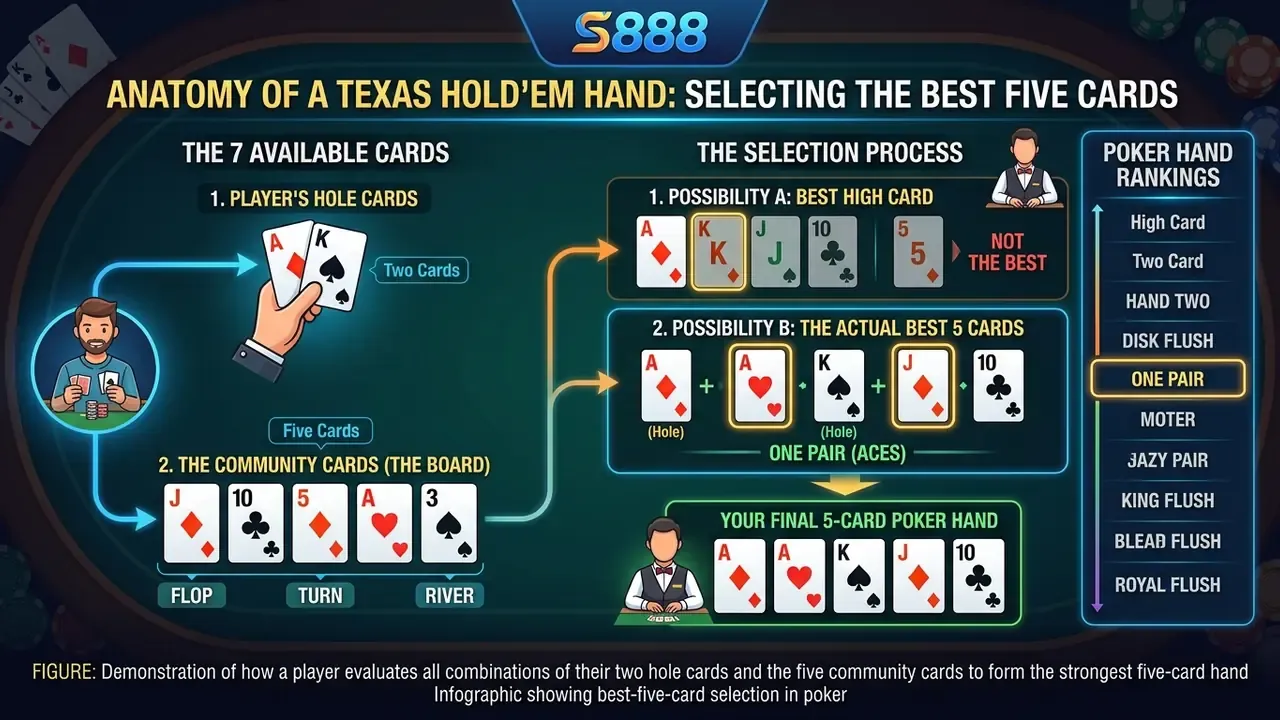
In two sentences: Each player receives two private cards and shares five community cards across four betting rounds. The final hand is the best five cards out of the seven available.

In Texas Hold'em, each player receives two private hole cards, followed by four betting rounds: pre-flop, flop, turn and river. Pre-flop betting begins immediately after the hole cards are dealt. The dealer then exposes three community cards at once (the flop), which opens the second round of wagering.

Infographic showing best-five-card selection in poker
Building a hand from 2 hole cards and 5 community cards

A fourth community card (the turn) lands on the board, followed by the third betting round. Finally the fifth community card (the river) appears, leading into the last betting round and showdown. To form a final hand, players use any combination of their two hole cards and the five community cards to build the strongest five-card holding, and playing the board alone is allowed when it beats what they hold.

Live poker and poker live dealer tables in online casinos

In two sentences: Live dealer poker streams a physical table from a studio and settles bets through a digital interface. Unlike PvP rooms, these games are banked by the house and resolved against a published paytable and a dealer qualification rule.

Live poker with a live dealer connects remote players to physical studio tables through real-time video streaming. Professional dealers shuffle real decks, manage table action and reveal cards on camera, while the digital interface records bets and computes payouts. You can compare that setup across online casinos with live dealer tables before committing funds. Common poker live dealer variants include Live Casino Hold'em, Live Caribbean Stud and Live Three Card Poker.

Live poker and poker live dealer

«Online casino participation rose from 0.5% to 0.8% of adults, and casino-style games were identified as a significant source of harm.» NSW Gambling Survey 2024, Browne et al.

The technology behind live poker tables

Real-time interactivity and verifiable dealing rest on two core components:

  1. GCU (Game Control Unit). A hardware encoder mounted beneath every table. It encodes the high-resolution video feed and synchronises it with the digital bet-acceptance system, so on-screen action and physical dealing stay aligned without perceptible lag.
  2. OCR (Optical Character Recognition). Dedicated cameras read the rank and suit of each physical card as it leaves the shoe, converting it instantly into digital data shown in the player interface.

Studios running these tables typically use multiple 4K cameras, broadcast-grade lighting and redundant network paths. For players, the practical benefit is transparency: every card is dealt on camera from a physical deck, which is why live tables answer the fairness objections that RNG-only products cannot fully settle.

The technology behind live poker tables

Dealer qualification rule

In house-banked games such as Caribbean Stud, Casino Hold'em and Royal Poker, the dealer must make a minimum qualifying hand, commonly Ace-King or better, or a pair, depending on the game, for the hand to be settled in full. If the dealer misses qualification, the Call bet is returned and the Ante pays 1:1, no matter how strong the player's hand happens to be. That threshold, not just the paytable, sets the real value of a premium holding.

HandAnte payout (Casino Hold'em)Call payout (Caribbean Stud)Side bet (5+1 Bonus)
Royal Flush100:1100:11000:1
Straight Flush20:150:1200:1
Four of a Kind10:120:150:1
Full House3:17:120:1
Flush2:15:115:1
Straight and below1:11:110:1 (three of a kind and above)

Figures above reflect common provider paytables. The exact schedule, the qualification rule and therefore the house edge are set by each individual table, so open the in-client rules panel and confirm the numbers before your first Ante.

FormatDealer presentPaceBet typeInteraction
Poker DemoNo (RNG)High, adjustableVirtual chips ($0)None
Standard RNG OnlineNo (RNG)Very high (multi-tabling)Real money, table limitsMinimal
Poker Live DealerYes (studio stream)Moderate (real dealing)Real money, house-bankedDealer and player chat
PvP Poker RoomsNo (RNG)High, tournament paceReal money, rakeTable text chat

In games like Live Caribbean Stud, each player receives five cards and faces a single dealer hand. Payouts rest on pre-set qualifying standards, such as the dealer needing Ace-King or better, plus optional bonus side bets that pay fixed odds on rare combinations like a Flush or Royal Flush, whether or not the dealer qualifies. Progressive jackpot pools attached to some Caribbean Stud tables have passed seven figures, and that is precisely why the side-bet house edge on those wagers usually runs much higher than on the main game.

Poker strategy for beginners: making decisions in a hand

In two sentences: Beginner poker strategy is a discipline problem before it is a maths problem: fold more, respect position, and price every call against the pot. Research links better decision accuracy to experience, and worse decisions to emotional reaction rather than missing knowledge.

Building an effective beginner strategy means stepping away from emotional decisions toward structured risk management, tight starting hand selection and basic pot odds work. Novices commonly play too many starting hands out of position, which leads to awkward post-flop spots and avoidable losses.

«Players with higher poker experience were significantly more likely to make correct decisions in No-Limit Hold'em scenarios (OR = 1.20 and 1.13 across two decision tasks).» Palomäki, doctoral thesis Poker Decision-Making & Self-Reflection (2024)

«Strategic discipline in poker relies on executing consistent rules based on position, equity and pot odds, rather than chasing marginal hands on tilt after a loss.» Claire Bennett, Senior iGaming Content Editor (editorial commentary; not a peer-reviewed finding)

[QUIZ: Real-money readiness assessment. Four questions covering bankroll, rules knowledge and discipline.]
Purpose: Help the user assess their level before moving to real stakes.
Semantics: section with role="form", multiple-choice options and text recommendations.

A mathematical framework starts with your hand's equity against the opponent's estimated range, assessed before you act. Decisions to check, call, bet or raise should always weigh the cost of the current bet against the total pot. Disciplined folding habits stop small tactical errors from turning into serious bankroll damage. Three rules carry most of the early benefit: play fewer hands from early position, avoid calling raises with dominated holdings such as A-9 offsuit, and never raise stakes to recover a loss inside the same session.

QUIZ Real-money readiness assessment. Four questions

How to assess starting cards and poker hand strength

In two sentences: Pre-flop value comes from rank, suitedness, connectivity and position. There are 169 distinct starting hand classes, and most of them belong in the muck from early seats.

Evaluating starting cards pre-flop rests on card rank, suit connectivity and table position. High pairs (A-A, K-K, Q-Q) and high suited connectors (A-K suited, A-Q suited) carry strong pre-flop equity, which makes them natural raising hands. Unsuited disconnected cards such as 7-2 or 9-4 carry very little equity and should go straight into the muck.

Palomäki records that players frequently attribute poor decisions to an emotional reaction to previous losses rather than to a gap in technical knowledge. Palomäki, doctoral thesis (2024)

Texas Hold'em holds 169 distinct starting hand combinations once suits are ignored: 13 pocket pairs, 78 suited combinations and 78 offsuit combinations. Early position calls for a tight, conservative range, because several players still act behind you. Late position allows a slightly wider range, using positional information on later streets. Range width should also flex with stack depth and with the action ahead of you, since an open, a single raise and a three-bet each demand a narrower continuing range than the one before it.

Using bets, limits and the pot in poker strategy

In two sentences: Pot odds convert a betting decision into a break-even percentage you can compare against your chance of improving. The Rule of 2 and 4 gives you that chance at the table, without a calculator.

Pot odds represent the ratio between the current pot and the cost of the call needed to continue. If the pot holds $100 and you face a $20 call, pot odds are 5 to 1, meaning the call needs to win roughly 16.7% of the time to break even. To justify continuing, the probability of completing a winning draw must beat that implied ratio.

[FIGURE: Pot odds and equity calculation with drawing hands. Caption: "A mathematical model for calling decisions".]
Purpose: Illustrate counting outs on the flop and the turn.
Semantics: figure + figcaption; alt: "Diagram showing pot odds calculation in poker".
Using bets, limits and the pot

Worked example: the Rule of 2 and 4

  1. Count your outs. Holding A♠ 7♠ on a board of K♠ 9♠ 3♦, any spade completes the flush. Thirteen spades exist, four are visible, so 9 outs remain.
  2. On the flop, multiply outs by 4 to estimate your chance of hitting by the river: 9 × 4 = 36%.
  3. On the turn, multiply outs by 2 for the single remaining card: 9 × 2 = 18%.
  4. Compare to pot odds. Pot $100, bet to call $20, so the break-even requirement is 16.7%. With 36% equity on the flop, calling is clearly profitable. With 18% on the turn against the same price, it is marginally profitable before implied odds enter the picture.
  5. Adjust for reality. Subtract equity when the draw may lose even after hitting (a flush into a possible full house), and add value when an opponent is likely to pay you off on the river.

Betting structures shape bankroll risk directly. Fixed-limit games restrict raise sizing, which keeps variance lower and protects players from losing a full stack in one hand. That is a mechanical property of the rules rather than a peer-reviewed finding, and public operator data has not independently quantified it. No-limit games allow an all-in at any point, which demands stricter stack management, clear loss limits and a solid grasp of bet sizing against aggressive opponents.

Worked example the Rule of 2

«The top 1% of online poker players by spend had a median outlay of €272,581 over two years, with a median of 1,149 sessions.» Tom et al., analysis of a major online operator's player data (2023)

That distribution is the practical argument for hard limits: the highest-volume tail of the player base is where both turnover and harm concentrate.

How to access a poker casino and choose a game format

In two sentences: Format selection should follow experience, bankroll and preferred pace, in that order. Confirm licensing, payout terms and safer-gambling controls before the first deposit, not after the first loss.

Choosing a poker format means matching your experience, available bankroll and risk tolerance against the technical demands of each game type. Decide whether you prefer software-driven RNG tables for rapid sessions, live dealer streams for a studio atmosphere, or multi-table tournaments for structured, buy-in capped play with a defined worst case.

[CHECKLIST: Choosing the right poker format]
Purpose: Interactive guide to format selection based on user parameters.
Semantics: list with checkbox inputs and descriptive DOM text.

- [ ] Step 1: Assess experience. Beginners should start with poker demo tables or micro-stakes fixed-limit games.
- [ ] Step 2: Define the budget. Ring-fence a bankroll whose loss would not affect your financial wellbeing (1 to 2% of that budget per session).
- [ ] Step 3: Choose the pace. Live dealer for slower play; standard RNG online or fast-fold for high hand volume.
- [ ] Step 4: Check platform terms. Confirm an official licence, transparent payout rules and responsible gambling tools (deposit limits, BetStop).
- [ ] Step 5: Configure protective limits. Set daily and weekly deposit caps before placing your first bet.

When you open any poker casino section, safety checks come first. Look for accessible account limits, self-exclusion options such as BetStop in Australia, transparent terms and conditions, and verified payout processing times. Check that the platform clearly displays current rules, wagering requirements and support channels before you deposit anything.

How to access a poker casino

«Regular online bettors support tools such as BetStop and deposit limits but describe them as reactive and insufficient to prevent harm.» NGTS Consumer Perspectives on Online Betting, Australian Gambling Research Centre (2023)

Red flags of offshore poker rooms

  • Withdrawal requests «under review» for weeks, with repeated document requests for the same information.
  • No licence number, or a licence number that cannot be verified on the regulator's register.
  • Bonus terms with wagering multiples above 40 times on poker or side-bet play, or wagering requirements that stay undisclosed until after deposit.
  • Maximum withdrawal caps far below the advertised jackpot or bonus value.
  • No published RTP, paytable or dealer qualification rule inside the game client.
  • Support available only through a web form, with no live chat and no complaints escalation path.
  • Pressure marketing: deposit-match countdowns, unsolicited «VIP manager» contact after a loss, or offers to reverse a pending withdrawal.
Red flags of offshore poker rooms

Disclaimer: This information is general in nature and does not replace professional advice. Real-money wagering is permitted only for adults in jurisdictions where it is legally allowed.

Deposits, withdrawals and KYC in online poker

In two sentences: Payment method availability, verification speed and withdrawal caps determine how much of your bankroll you actually control. Complete KYC before you win, not after.

Most friction in real-money poker happens at the cashier, not the table. Two habits cut most of it: use one payment method for both deposit and withdrawal wherever possible, and submit verification documents on the day you register.

MethodTypical deposit speedTypical withdrawal speedCommon notes
PayID / bank transferMinutes to a few hours1 to 3 business daysBank name must match account name; some banks decline gambling merchants
Visa / MastercardInstant3 to 5 business daysCard withdrawals are often unavailable; many banks block gambling MCC codes
Skrill / NetellerInstantSame day to 24 hoursFastest e-wallet route; e-wallet deposits are often bonus-excluded
Neosurf / prepaid voucherInstantNot available for payoutsDeposit-only; you must nominate an alternative withdrawal method
Cryptocurrency10 to 60 minutesMinutes to 24 hoursNetwork fees apply; value fluctuates between deposit and cash-out
Direct bank / EFT1 to 2 business days2 to 5 business daysHighest limits, slowest end to end

Speeds above are indicative ranges observed across operators, not guarantees. Each platform publishes its own processing windows, fees and limits in its banking terms.

What KYC actually requires. Expect to supply photo ID (passport or driver licence), proof of address dated within the last three months (utility bill or bank statement), and proof of payment ownership (a card image with middle digits masked, or an e-wallet screenshot). Verification is commonly completed within 24 to 72 hours when documents are legible and names match exactly. Mismatched names, cropped documents and expired ID are the three most frequent causes of delay, and all three are avoidable.

Withdrawal terms worth checking before depositing:

  • Weekly and monthly payout caps. A large tournament win may be paid in instalments.
  • Pending or reversal periods. Some rooms hold withdrawals for 24 to 48 hours and let you cancel them, which is a documented risk factor for reinvesting winnings.
  • Minimum withdrawal amount, plus any fee on payouts below a threshold.
  • Bonus and wagering status. Funds tied to an unmet rollover requirement usually cannot be withdrawn, and requesting a payout commonly forfeits the bonus balance.
  • Currency conversion. Playing in a non-AUD wallet adds a conversion spread at both ends.
Speeds above are indicative ranges observed

Financial disclaimer: Payment availability, fees and processing times are set by operators, payment providers and banks, and they change without notice. This section is general information, not financial advice.

Who should skip this format, and where to get help

Poker rewards volume, patience and emotional flatness. For some players it is a poor fit, and no amount of strategic content changes that.

Consider skipping real-money poker entirely if you:

  • are under 18;
  • would be wagering money allocated to rent, bills, groceries or debt repayment;
  • have previously raised stakes to recover a loss inside the same session;
  • gamble in response to stress, boredom, grief or conflict;
  • conceal the amount or frequency of play from a partner or family member;
  • are currently registered with BetStop or another self-exclusion scheme;
  • find that fast-fold or multi-table play makes stopping at a pre-set limit difficult.

Demo tables stay available at no financial risk, and they remain the appropriate way to enjoy the mechanics of the game if any of the above applies to you.

Australian support services:

  • Gambling Help Online, 1800 858 858. Free and confidential, 24 hours a day, seven days a week, with online chat and email counselling.
  • BetStop. The National Self-Exclusion Register; one registration blocks accounts and marketing across Australian-licensed interactive wagering providers.
  • Lifeline, 13 11 14, for immediate crisis support.
Who should skip this format, and

Health disclaimer: Gambling harm is a recognised health issue. The information here is general and does not replace assessment or treatment by a qualified clinician or financial counsellor.

FAQ: online poker questions Australian players ask

Is online poker legal in Australia?

The Interactive Gambling Act 2001 prohibits the supply and advertising of prohibited real-money interactive gambling services, online poker included, to people located in Australia. The offence sits with the operator, not the individual player, and the ACMA can have non-compliant offshore sites blocked. Practical risk for players therefore centres on limited recourse if funds are withheld. This is general information, not legal advice.

What is the minimum age to play poker for real money?

Eighteen, across all Australian jurisdictions. Licensed operators must verify age through KYC before payouts, and accounts opened by minors are voided.

Can I withdraw bonus money immediately?

Usually not. Bonus funds normally carry wagering requirements, expiry windows (often 7 to 30 days) and sometimes game restrictions. Requesting a withdrawal before those conditions are met commonly forfeits the bonus and any winnings derived from it.

How long does KYC verification take?

Commonly 24 to 72 hours when documents are clear, current and name-matched. Submit them at registration, because the most expensive delays happen when verification only begins after a large win.

Does winning in demo mode mean I will win for real money?

No. Free-play environments remove financial pressure, and opponents at demo tables behave differently. Research on simulated gambling found 54% of real-money online gamblers had also played simulated products, with higher engagement and higher harm levels (Fiedler et al., 2024). Free-play performance is not a profitability indicator.

Is poker live dealer the same as PvP online poker?

No. Live dealer poker (Casino Hold'em, Caribbean Stud, Three Card Poker) is house-banked: you play against a fixed paytable and a dealer qualification rule, with a built-in house edge. PvP poker rooms are player-versus-player, and the operator earns a rake instead of an edge.

What is the difference between Hold'em and Omaha?

Hold'em deals two hole cards, both optional. Omaha deals four hole cards and requires exactly two of them plus three board cards, which lifts average showdown hand strength substantially.

What is a PKO tournament?

Progressive Knockout. Each elimination pays you a cash bounty, half immediately and half added to your own bounty, so your head becomes progressively more valuable as knockouts accumulate.

Which cards and chips should I buy for a home game?

For 7 to 10 players, a set of 200 to 300 chips in four or five denominations. Use 100% plastic decks such as Copag for durability in serious games; plastic-coated cardstock decks such as Bicycle are fine for casual nights.

How many hands per hour should I expect online?

Roughly 60 to 90 at a single standard table, and considerably more across multiple tables or in fast-fold formats. Higher hand volume compresses variance into shorter timeframes, which is why session and loss limits matter more online than in a live room.